
Learning Tai Chi
Learning Tai Chi with Movement in Mind
Learning Tai Chi is unlike learning most forms of exercise.
Rather than aiming for speed, intensity or perfection, Tai Chi is learnt gradually through repetition, curiosity and regular practice. Each movement builds on the one before it, allowing balance, coordination and confidence to develop naturally over time.
There is no expectation to “get it right” straight away. In fact, one of the joys of Tai Chi is that every time you practise, you notice something new.
Whether you are completely new to Tai Chi or returning after a break, learning is a journey rather than a destination.
Beginning with the Basics
Everyone starts with the fundamentals.
Before learning longer sequences, beginners explore simple movements that introduce the key principles of Tai Chi, including:
- posture and alignment
- relaxed, natural breathing
- weight transfer
- balance and stability
- coordinated whole-body movement
- moving with awareness
These foundations are much more important than memorising lots of movements.
As confidence grows, the movements become smoother, more comfortable and increasingly connected.
Learning Through Repetition
In many Western activities, repeating the same movement can seem repetitive.
In Tai Chi, repetition is one of the most valuable ways of learning.
Repeating movements allows the body to become familiar with new patterns of movement without rushing. Over time, what once required concentration begins to feel more natural and effortless.
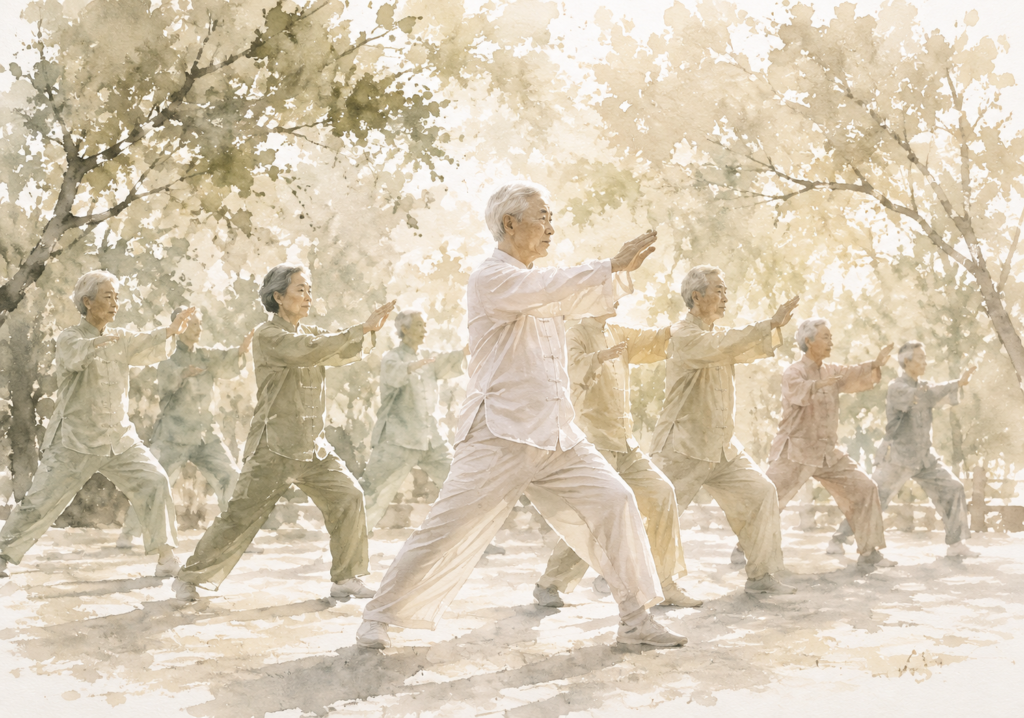
Rather than striving to perfect each movement, practitioners gradually develop:
- better coordination
- greater balance
- increased body awareness
- smoother movement
- growing confidence
Each repetition becomes an opportunity to notice something different.
Traditional Forms and Adapted Programmes
Traditional Tai Chi forms have been passed down through generations and remain at the heart of the practice.
Over time, teachers have also developed shorter and adapted programmes to make Tai Chi more accessible to modern learners and to people living with health conditions or reduced mobility.
These adaptations are not a different form of Tai Chi. They retain the essential principles of the practice while making it easier for more people to begin safely and confidently.
Many people start with shorter forms before progressing to longer traditional sequences if they choose.
Learn at Your Own Pace
No two people learn Tai Chi in exactly the same way.
Some enjoy remembering movement sequences quickly, while others prefer to spend time becoming comfortable with each movement before moving on.
Neither approach is better than the other.
Tai Chi encourages patience rather than comparison. Progress is measured less by how many movements you know and more by how naturally and comfortably you move.
Everyone develops at their own pace.
Adapting to Individual Needs
Tai Chi is remarkably adaptable.
Movements can often be modified to suit different levels of mobility, confidence and physical ability. For some people this may mean reducing the size of a movement. Others may choose to practise seated for part or all of a session.
Adapting movement is not a sign of doing Tai Chi “incorrectly”.
The aim is always to preserve the principles of relaxation, balance and mindful movement while working within your own comfort and abilities.
Developing a Lifelong Practice
Tai Chi is sometimes described as a lifelong art because there is always more to discover.
As movements become familiar, attention naturally shifts towards subtler aspects of practice:
- moving with greater ease
- refining balance and coordination
- developing relaxation
- becoming more aware of breathing
- responding more naturally to movement
Many people find that the greatest changes happen gradually, not only in their practice but in everyday life.
Learning Beyond the Class
Regular classes provide guidance, encouragement and opportunities to learn from an experienced teacher.
Equally important is finding small opportunities to practise between classes.
Even a few minutes of regular practice can help movements become more familiar and build confidence over time.
Tai Chi is less about practising for long periods and more about developing a consistent relationship with movement.
At Movement In Mind
Our approach to teaching Tai Chi is welcoming, supportive and adaptable.
We encourage people to begin where they are, without pressure to perform or keep up with others.
Movements are introduced gradually, with time to explore and understand the underlying principles rather than simply memorising a sequence.
Whether your goal is improving balance, supporting your wellbeing or learning the traditional art of Tai Chi, our aim is to help you develop confidence and enjoyment in your own practice.
Continue Exploring
You may also enjoy:
- About Tai Chi – Discover the history, principles and philosophy of Tai Chi.
- Tai Chi Styles – Learn about the five major styles of Tai Chi and why we teach Yang and Sun Style.
- About Qi Gong – Explore the similarities and differences between Tai Chi and Qi Gong.
- Embodied Wellbeing – Discover how mindful movement supports health and wellbeing.
- Health Conditions – Learn how Tai Chi can often be adapted for people living with long-term health conditions.