Health Conditions
Tai Chi and Stroke Recovery
Supporting movement, confidence and everyday wellbeing
Recovery after a stroke can be a gradual and sometimes unpredictable process. You may experience changes in strength, balance, coordination or mobility, or find that everyday movements require more thought and effort than they once did.
Physical activity is an important part of life after stroke, but the right type and level of activity will be different for everyone. NICE recommends physical activity after stroke, with exercise programmes tailored to individual needs, abilities and goals. (Nice)
At Movement In Mind, Tai Chi and Qi Gong offer a gentle way to continue exploring movement alongside your usual rehabilitation and healthcare support.
Why Tai Chi?
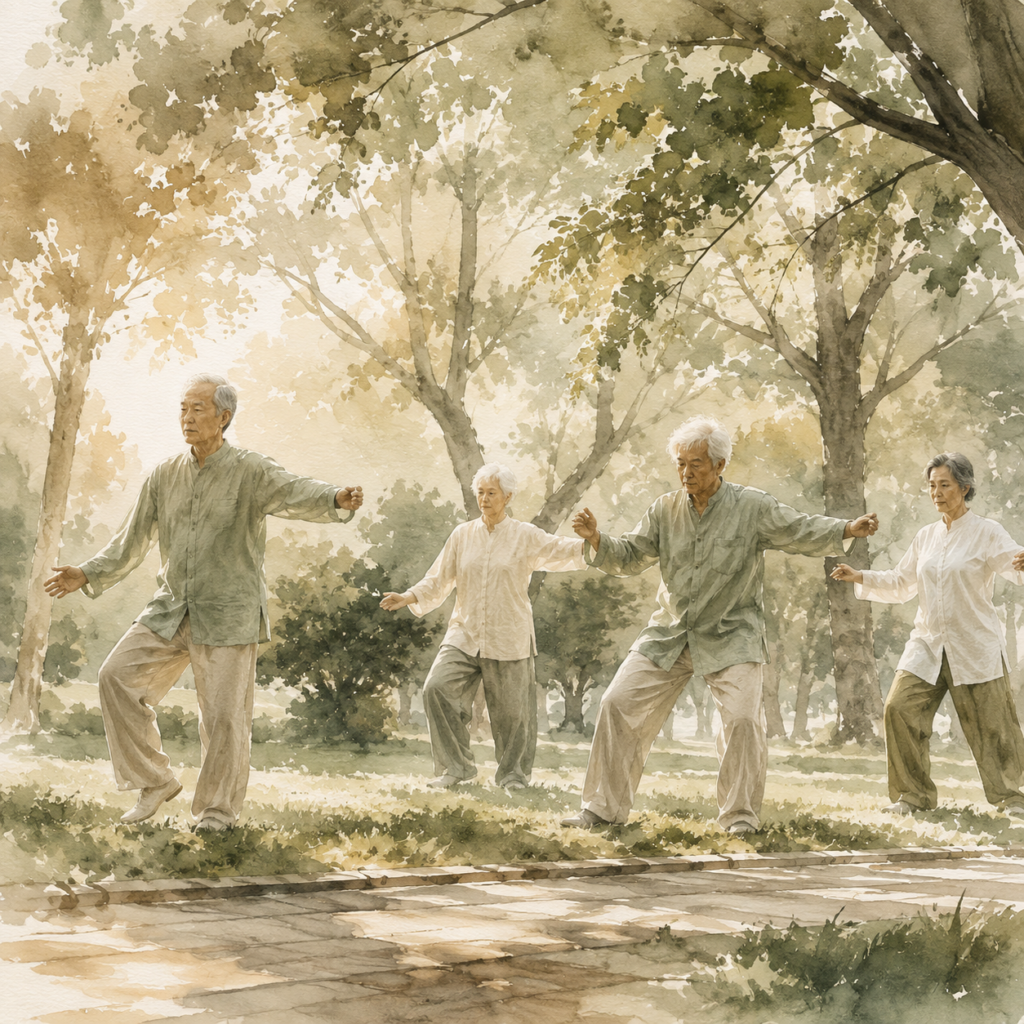
Tai Chi involves slow, deliberate movements, changes of weight, shifting balance and coordinated movement of the arms and legs.
This gives us opportunities to practise:
- Balance and stability
- Weight shifting
- Coordination
- Posture and alignment
- Mobility
- Awareness of how we move
- Confidence in everyday movement
Balance problems are common after stroke and can affect both physical safety and confidence. (Stroke Association shop) Tai Chi provides a way of exploring balance in a calm and supported environment, without the pressure of moving quickly or keeping up with others.
Recovery isn’t always a straight line
Stroke recovery can continue long after the initial period of rehabilitation. Progress may not always be obvious, and what feels manageable can vary from one day to another.
Our approach is not about pushing through difficulties or trying to make your body perform in a particular way.
Instead, we encourage you to notice what is possible today.
A movement might need to be smaller. You might need to practise seated rather than standing. You may need more time to find your balance or coordinate a movement.
That’s all part of the practice.
There is no “right” version of a movement. There is the version that works for you today.
Tai Chi alongside rehabilitation
Tai Chi isn’t a replacement for physiotherapy, occupational therapy or other stroke rehabilitation.
If you are still receiving rehabilitation, we encourage you to follow the advice of your healthcare team. NICE recommends that exercise after stroke is assessed and tailored to the person’s individual needs and goals, with appropriate guidance and adaptations. (Nice)
Once you have been advised that independent exercise is appropriate, a gentle Tai Chi practice can become one of the ways you continue to stay active and develop confidence in movement.
Community activities can also provide opportunities for social participation and wellbeing after stroke, alongside more formal rehabilitation. (Nice)
Our approach
Everyone’s experience of stroke is different, so we don’t have a standard expectation of what you should be able to do.
Our teaching focuses on:
- Gentle progression – movements are introduced gradually.
- Adaptability – movements can be modified to suit your abilities.
- Repetition – familiar movements give you opportunities to build confidence.
- Awareness – we encourage you to notice how movement feels rather than simply copying a shape.
- Encouragement – there is no competition and no expectation to keep up.
- Enjoyment – recovery is more than rehabilitation exercises; movement can also be something you enjoy.
We also have experience of working with people living with different levels of mobility and health challenges, so we’re accustomed to finding practical ways for people to participate.
You don’t have to move perfectly
One of the things we particularly value about Tai Chi is that it gives us permission to slow down.
You don’t have to reproduce a movement exactly as the teacher does. You can explore the principle of the movement within your own range and ability.
Over time, this can help you become more familiar with your body and perhaps more confident in what it can do.
The aim isn’t to compare where you are now with where you were before your stroke.
It’s about discovering what movement can look like now.
Is Tai Chi suitable for me?
Tai Chi can be adapted in many ways, but stroke affects people differently.
If you have significant balance difficulties, weakness, dizziness, visual problems, communication difficulties or other symptoms that could affect your safety, please discuss starting a new physical activity with your healthcare professional.
Our classes are not stroke rehabilitation services and are not a substitute for specialist medical or physiotherapy care.
We can, however, provide a supportive environment in which to continue developing your movement practice once you’re ready to participate safely.
Beginning your practice
If you’d like to explore Tai Chi after stroke, our Learn Tai Chi course offers a gentle introduction to the foundations of the practice.
You don’t need previous Tai Chi experience, and you don’t need to be particularly fit or flexible. Movements can be adapted, and you’ll be encouraged to work at your own pace.
Practice videos are also available to help you revisit what you’ve learned between sessions.
A practice that can grow with you
Stroke recovery isn’t simply about getting back to where you were.
It’s also about discovering how you can move, participate and live well now.
Tai Chi offers a practice you can return to repeatedly, adapting it as your confidence, abilities and needs change.
You don’t have to force your way back to movement. You can explore it gently, one movement at a time.