
Health Conditions
Tai Chi and Parkinson’s
Supporting movement, balance and confidence
Living with Parkinson’s can bring changes to the way you move, sometimes gradually and sometimes unpredictably. Stiffness, slowness of movement, changes in balance and coordination, fatigue and changes in confidence can all affect everyday life.
Regular physical activity is an important part of living well with Parkinson’s. The right activity will be different for everyone, but staying active can support physical and mental wellbeing and help people maintain their ability to move and manage everyday activities. (Parkinson’s UK)
At Movement In Mind, we use Tai Chi and Qi Gong as gentle, mindful movement practices that can complement other forms of exercise and professional support.
Why Tai Chi?
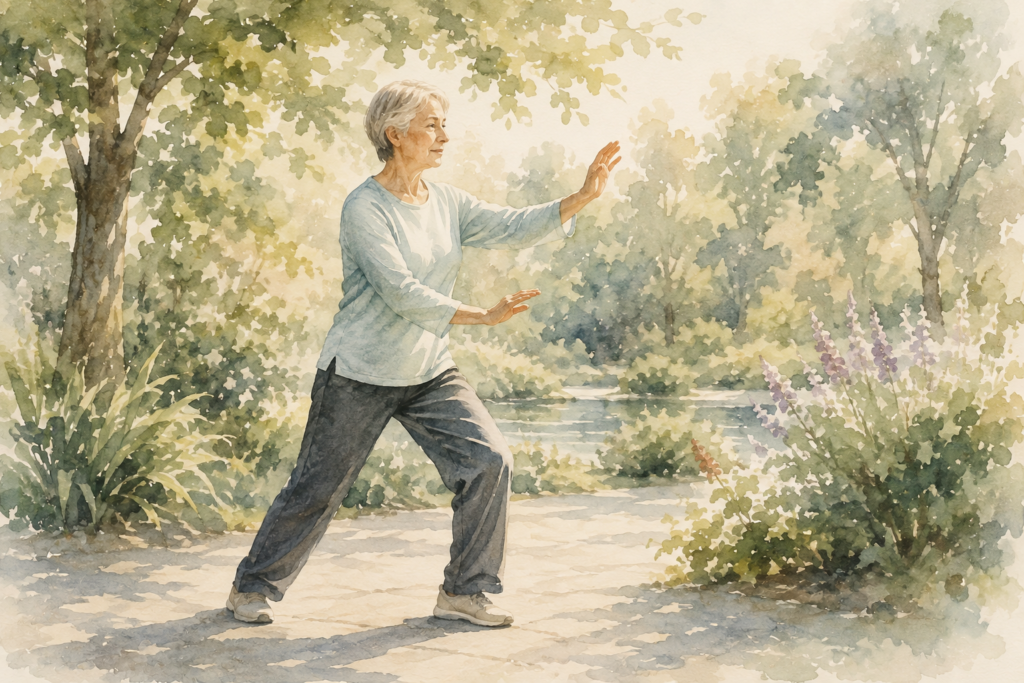
Tai Chi combines slow, flowing movements with attention, coordination and changes in weight and direction.
These qualities make it particularly interesting for people with Parkinson’s. Parkinson’s UK specifically identifies Tai Chi as one activity that can help with coordination and balance, while its exercise framework includes Tai Chi among activities that develop flexibility and strength. (Parkinson’s UK)
Tai Chi gives us an opportunity to practise:
- Balance and weight shifting
- Coordination
- Posture and alignment
- Controlled, purposeful movement
- Mobility and flexibility
- Awareness of how we move
The movements are performed slowly enough to give you time to notice what you’re doing, rather than rushing from one position to the next.
Movement doesn’t have to be perfect
Parkinson’s can make some movements feel less predictable. You may have days when you feel more mobile and days when everything feels harder.
Our approach recognises this.
We don’t expect you to perform movements perfectly or keep up with anyone else. Movements can be adapted to suit how you’re feeling on the day, and seated options can be used when appropriate.
The aim isn’t to overcome Parkinson’s through willpower. It’s to develop a more confident and adaptable relationship with movement.
What does the research say?
Research into Tai Chi and Parkinson’s has explored areas including balance, postural stability, mobility and quality of life. The wider evidence on physical activity and exercise in Parkinson’s supports regular, appropriately tailored activity as part of managing the condition. (Parkinson’s UK)
Tai Chi should be understood as one part of a broader approach to living well with Parkinson’s, rather than as a treatment or cure.
Your individual needs, symptoms and goals matter. A physiotherapist or other member of your Parkinson’s care team can advise on the types and intensity of exercise that are appropriate for you. Parkinson’s UK recommends physiotherapy for people with Parkinson’s, particularly where there are movement or balance difficulties. (Parkinson’s UK)
Our approach
We have experience of working with people living with Parkinson’s and understand that everyone’s experience is different.
Our sessions are:
- Gentle and adaptable – movements can be modified to suit your needs.
- Non-competitive – there’s no pressure to keep up.
- Focused on awareness – we encourage you to notice how movement feels.
- Progressive – movements are introduced gradually and revisited regularly.
- Supportive – you’re learning alongside other people in a welcoming environment.
We also recognise the value of repetition. Returning to familiar movements can help build confidence and give you an opportunity to notice subtle changes in how you move.
When you’re having a difficult day
You don’t have to miss your practice simply because you’re not feeling at your best.
Sometimes a smaller range of movement, a slower pace or practising from a chair is the right choice.
Our philosophy is adapt, don’t abandon.
The purpose of practice isn’t to prove what you can do on your best day. It’s to find ways of staying connected with movement that are sustainable over time.
Is Tai Chi suitable for me?
Tai Chi can be adapted for many different abilities, but Parkinson’s affects people in different ways.
If you have significant balance difficulties, freezing, falls, dizziness or other symptoms that affect your safety, it’s important to discuss your activity plans with your physiotherapist, Parkinson’s nurse or other healthcare professional.
Our classes aren’t a replacement for specialist Parkinson’s care or physiotherapy. Instead, Tai Chi can sit alongside the wider support you receive.
Beginning your practice
If you’d like to explore Tai Chi, our Learn Tai Chi course provides a supportive introduction to the foundations of the practice.
You don’t need previous experience, and you don’t need to be particularly fit or flexible. We’ll guide you through the movements gradually, with options to adapt your practice when needed.
You can also use the practice videos between sessions to revisit movements and build familiarity at your own pace.
A practice for the long term
Parkinson’s is a condition that changes over time, but that doesn’t mean your relationship with movement has to stop developing.
Tai Chi offers something you can return to again and again. The movements can be explored in different ways as your needs change, and the practice can continue to be part of a wider approach to maintaining mobility, confidence and wellbeing.
It’s not about moving perfectly. It’s about continuing to move, with awareness, curiosity and support.