
Health Conditions
Living with Arthritis
Arthritis affects millions of people and can make everyday activities more challenging.
Whether it’s opening a jar, climbing the stairs, getting up from a chair or simply walking comfortably, pain and stiffness can gradually affect confidence as well as mobility.
Although there are many different forms of arthritis, one thing they often have in common is that movement becomes more difficult—and sometimes something we begin to avoid.
This is completely understandable.
When movement is painful, it can feel safer to rest. Yet keeping joints moving, within comfortable limits, is an important part of managing many forms of arthritis.
Tai Chi and Qi Gong offer a gentle, adaptable way of staying active, helping many people move with greater confidence, ease and comfort.
Understanding Arthritis
Arthritis isn’t a single condition. It describes more than 100 conditions that affect the joints and surrounding tissues.
Some of the most common include:
- Osteoarthritis, where the protective cartilage within joints gradually wears down.
- Rheumatoid arthritis, an autoimmune condition that causes inflammation within the joints.
- Psoriatic arthritis, associated with psoriasis.
- Gout, caused by a build-up of uric acid crystals within joints.

Although each condition is different, many people experience symptoms such as:
- joint pain
- stiffness
- swelling
- reduced movement
- fatigue
- difficulty with everyday activities
Treatment depends on the type of arthritis and may include medication, lifestyle changes, physiotherapy and regular physical activity.
Why Movement Matters
It can seem surprising that movement is recommended when your joints hurt.
However, regular gentle movement helps maintain joint mobility, strengthen the muscles that support the joints and improve overall function.
Without regular movement, joints can become stiffer, muscles weaken and everyday activities often become more difficult.
The key is finding movement that feels manageable and sustainable.
Tai Chi and Qi Gong are particularly well suited because they are:
- low impact
- slow and controlled
- adaptable
- suitable for different levels of mobility
- easy to progress gradually
Rather than encouraging people to push through pain, they emphasise working within comfortable limits and moving with awareness.
How Tai Chi and Qi Gong May Help
Tai Chi and Qi Gong combine gentle movement, balance training, relaxed breathing and mindful attention.
Many people living with arthritis find they help them to:
- improve joint mobility
- reduce stiffness
- develop better balance
- strengthen muscles that support the joints
- improve posture and coordination
- increase confidence in movement
- feel calmer and more relaxed
The emphasis is never on forcing movement.
Instead, movements are adapted to suit the individual and practised with patience and care.
What Does the Research Say?
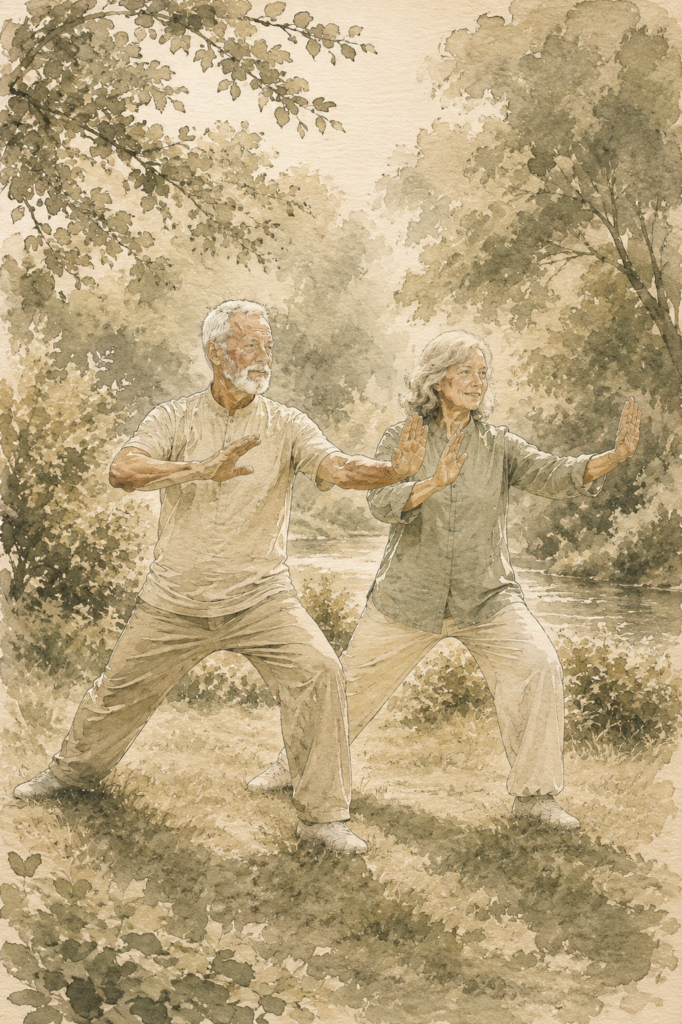
Tai Chi is one of the most extensively researched mind-body practices for people living with arthritis.
Research suggests it may help improve pain, physical function and quality of life for some people with osteoarthritis, particularly of the knee and hip. It is also widely recognised as a safe form of physical activity for many older adults when appropriately taught. Professional bodies, including the American College of Rheumatology, recommend Tai Chi as part of the management of knee and hip osteoarthritis. For rheumatoid arthritis, the evidence is encouraging but currently less conclusive, with more research still needed.
Tai Chi and Qi Gong should be seen as complementary practices that may support overall wellbeing alongside the treatment recommended by your healthcare team. They are not a cure for arthritis.
You can read more in our Research & Evidence section.
Adapting Practice
One of the greatest strengths of Tai Chi and Qi Gong is that they can often be adapted to suit different abilities.
Depending on your needs, you might:
- reduce the size of movements
- move more slowly
- take shorter practice sessions
- remain seated for some or all of the practice
- rest whenever you need to
At Movement In Mind, we encourage everyone to work within their own comfort rather than trying to achieve large movements or perfect technique.
Is Tai Chi Suitable for Everyone?
Many people living with arthritis can enjoy Tai Chi and Qi Gong safely.
If you’ve recently had surgery, your symptoms have changed significantly or you’re unsure what level of activity is appropriate, it’s always sensible to discuss this with your GP, consultant or physiotherapist before starting a new programme.
An experienced teacher should also be able to suggest adaptations to help you practise comfortably.
A Gentle, Sustainable Practice
Many forms of exercise can feel intimidating when you’re living with persistent pain or stiffness.
Tai Chi and Qi Gong offer a different approach.
Rather than measuring success by how hard you work, they encourage you to move with greater awareness, balance and ease.
For many people, this gentle, sustainable approach makes it easier to continue moving—and it’s regular movement over time that often brings the greatest benefits.
Continue Exploring
You may also enjoy:
- Health Conditions – Explore our guide to living well with long-term health conditions.
- Research & Evidence – Read more about the evidence supporting Tai Chi and Qi Gong.
- About Tai Chi – Learn about the history and principles of Tai Chi.
- About Qi Gong – Discover another gentle movement practice that can support wellbeing.
- Embodied Wellbeing – Explore how movement and body awareness support health and wellbeing.