
Tai Chi Styles
Tai Chi Styles
People are often surprised to discover that there isn’t just one style of Tai Chi.
Over the centuries, different families developed their own ways of practising the art. Although each style has its own character and emphasis, they all share the same underlying principles of relaxed movement, balance, coordination and mindful awareness.
At Movement In Mind, we teach Yang Style and Sun Style Tai Chi because they are particularly well suited to promoting health and wellbeing. Both styles can be adapted to meet different levels of mobility and experience, making them accessible to a wide range of people.
Did you know?
Some of the earliest people to teach Yang Style Tai Chi in Europe and America were women from dance backgrounds. Their contribution is often overlooked today.
The Main Styles of Tai Chi
The five traditional family styles are Chen, Yang, Wu (Hao), Wu and Sun. Each developed from the same martial tradition but evolved in slightly different ways.
Chen Style is the oldest form of Tai Chi. It combines slow, flowing movements with occasional bursts of faster, more explosive techniques. It retains many of its martial arts characteristics and is often physically demanding.
Developed from Chen Style, Yang Style is the most widely practised form of Tai Chi throughout the world.Its movements are smooth, continuous and graceful, with relaxed postures and gentle weight shifting. Because it is easy to adapt for different abilities, Yang Style has become one of the most popular styles for promoting health, improving balance and supporting general wellbeing.
Wu Style is characterised by smaller, compact movements and subtle shifts of weight. It places great emphasis on precision, relaxation and balance.
Less commonly seen outside China, Wu (Hao) Style features small, refined movements with a strong focus on posture, internal awareness and controlled movement.
The newest of the traditional family styles, Sun Style was developed in the early twentieth century by Sun Lutang. It combines smooth, flowing movements with agile stepping and upright postures. Because it avoids deep stances and places less stress on the joints, it is particularly suitable for older adults, beginners and people living with long-term health conditions.
Why We Teach Yang and Sun Style
At Movement In Mind, our focus is on health, wellbeing and helping people develop confidence in movement. For this reason, we have chosen to specialise in Yang Style and Sun Style.
Yang Style develops strength, balance, coordination and flexibility through flowing, continuous movements that encourage the whole body to work together.
Sun Style shares these same principles while using higher stances and gentle stepping patterns that many people find particularly comfortable if they have joint pain, reduced mobility or balance concerns.
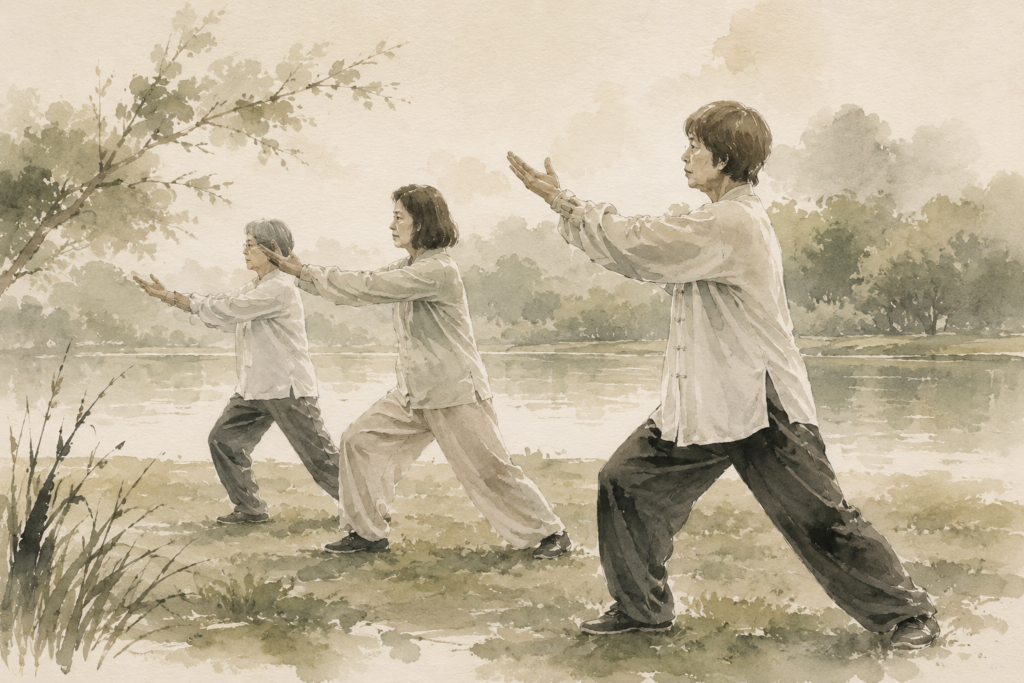
Both styles encourage relaxed, mindful movement rather than physical effort or athletic performance.
Traditional Tai Chi and Adapted Practice
Tai Chi began as a martial art, and traditional forms can contain long sequences of movements that take time to learn.
Over recent decades, experienced Tai Chi teachers and healthcare professionals have worked together to develop shorter programmes that retain the essential principles of Tai Chi while making the practice more accessible.
At Movement In Mind, we teach both traditional forms and adapted practices.
Our adapted sessions are designed for people who may be living with health conditions, returning to exercise, or simply looking for a gentle introduction to Tai Chi. Movements can be modified where appropriate, allowing people to work safely and comfortably within their own abilities.
We believe that adaptation need not mean dilution. When guided by sound Tai Chi principles, appropriate modifications allow more people to experience the benefits of the art while remaining respectful of its traditional foundations.
The Tai Chi for Health Programmes
Some of our beginner and therapeutic classes draw on programmes developed by the Tai Chi for Health Institute, founded by Dr Paul Lam and colleagues.
These programmes combine traditional Tai Chi principles with current knowledge of health, rehabilitation and exercise science. They have been designed to support people living with a range of health conditions while remaining enjoyable, safe and accessible.
Shirley is a qualified instructor in several Tai Chi for Health programmes, including:
- Tai Chi for Arthritis and Falls Prevention
- Tai Chi for Diabetes
- Tai Chi for Osteoporosis
These programmes provide an excellent introduction to Tai Chi and are often a stepping stone towards learning the traditional forms.
Learning at Your Own Pace
Many people worry that they won’t be coordinated enough or will struggle to remember the movements.
In reality, Tai Chi is a practice that unfolds gradually. There is no expectation to learn everything at once, and everyone progresses at their own pace.
Some people enjoy learning the longer traditional forms, while others prefer shorter sequences that fit more easily into everyday life. Both approaches offer opportunities to improve balance, mobility, strength and wellbeing.
The aim is not to perform perfect movements, but to develop greater ease, awareness and confidence in the way you move.
Which Style Is Right for You?
For most people, the answer is simple—you don’t need to choose.
Our classes are carefully structured to introduce movements progressively, allowing you to build confidence before moving on to more complex forms if you wish.
Whether you begin with a traditional Yang Style sequence or one of our adapted Sun Style programmes, you’ll be learning the same underlying principles that have supported health and wellbeing for generations.
The most important step is simply to begin.
Continue Exploring
You may also be interested in:
- About Tai Chi – Learn about the origins, philosophy and principles of Tai Chi.
- Why Tai Chi Benefits Health – Discover why this gentle practice has such wide-ranging benefits for physical and emotional wellbeing.
- Tai Chi for Health Conditions – Explore how Tai Chi may support people living with arthritis, osteoporosis, diabetes and other long-term health conditions.