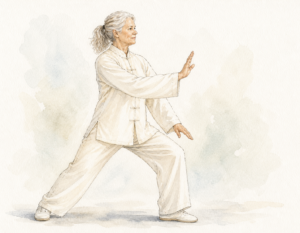
Brush Knee and Push is one of the most recognisable and frequently repeated movements in Tai Chi, appearing in many forms and styles. At first glance, it seems simple—one hand brushes past the knee while the other pushes forward—but within this sequence lies a rich interplay of coordination, intention, and whole-body connection.
At its heart, Brush Knee and Push teaches us how to move forward with stability and ease. The “brush” hand clears the path, gently guiding energy downward and away, while the “push” expresses forward intention. This is not a forceful action, but a soft extension—like opening a door rather than shoving it.
The movement begins from the ground. As the weight shifts, the rear foot roots into the earth, providing a stable base. This rooting allows energy to travel upward through the legs, guided by the waist, and expressed through the arms. When practiced with awareness, the hands do not act independently—they are simply the final expression of the body’s coordinated movement.
A key aspect of Brush Knee and Push is the role of the waist. It is the turning of the waist that initiates the action, aligning the body and directing both hands in harmony. Without this central coordination, the movement can become disjointed or overly reliant on the arms.
There is also a subtle rhythm to the posture. The brushing hand and pushing hand are not separate actions but part of a continuous flow. As one hand descends and softens, the other rises and extends. Yin and yang are constantly transforming—yielding and expressing, emptying and filling.
In practice, it can be tempting to focus on the outward shape: where the hands go, how far to step, how low to sink. But the deeper work lies beneath the surface. Can you remain relaxed while maintaining structure? Can you move forward without leaning? Can the breath remain smooth and natural as the body shifts?
Brush Knee and Push also offers a reflection beyond the physical. It reminds us of the balance between clearing and progressing. Before we move forward, we often need to let go—of tension, of distraction, of resistance. The brushing action becomes a metaphor for this clearing, while the push represents calm, intentional progress.
Over time, this movement becomes less about technique and more about feeling. The distinction between brushing and pushing softens into a single, continuous gesture—grounded, connected, and quietly powerful.
Like many aspects of Tai Chi, Brush Knee and Push reveals more the slower and more attentively it is practiced. Each repetition is an opportunity to refine balance, deepen awareness, and rediscover the subtle harmony between effort and ease.
1. Prepare and Shift the Weight
Begin from the previous posture with your weight settled into one leg (often the rear leg). Allow the body to relax and sink slightly, keeping the spine upright and the crown gently lifted. Your hands are naturally positioned, ready to circle.
2. Turn the Waist and Open the Arms
Initiate the movement from the waist. As you rotate, allow both arms to move together as one connected unit.
- The rear hand begins to rise and arc forward.
- The front hand begins to lower and move inward.
Keep the shoulders relaxed and avoid independent arm movement—everything is led by the centre.
3. Step Forward
As the body turns, lift the front foot and step forward smoothly, placing the heel down first.
- The step should be light and controlled.
- Place the foot along a slight angle (not directly on a tightrope), maintaining stability.
4. Brush the Knee
As your weight begins to transfer forward:
- The front hand passes down and across the front of the body, gently “brushing” past the knee.
- The palm faces inward or slightly downward.
This is a soft clearing action, not a forceful sweep.
5. Push Forward
At the same time:
- The rear hand travels forward from near the waist or chest.
- It extends outward at about chest height, palm facing forward.
The push is relaxed and connected—energy travels from the back foot, through the legs and waist, and out through the palm.
6. Complete the Weight Transfer
Shift your weight fully onto the front leg:
- The front knee bends naturally (not beyond the toes).
- The rear leg remains rooted and extended but not locked.
Your body remains upright—avoid leaning forward into the push.
7. Settle and Align
At the end of the movement:
- One hand is extended forward (push).
- The other rests near the side of the knee (brush).
- Hips and shoulders are aligned, guided by the waist.
- Breathing remains calm and natural.
Key Points to Remember
- Movement is initiated by the waist, not the arms.
- Keep a sense of continuous flow—no breaks between brush and push.
- Stay relaxed but structured.
- Let the whole body move as one connected unit.
With practice, these steps begin to merge into a single, fluid action—grounded below, expressive above, and always guided by the centre.