
Yang Style and Sun Style Tai Chi
Parry and Punch is one of those movements that often looks simple from the outside, yet reveals more depth the longer you practise. It appears in both Yang Style and Sun Style Tai Chi, but each style expresses it in a slightly different way, offering us different physical sensations and learning opportunities.
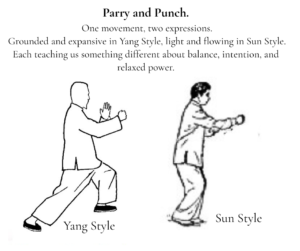
In Yang Style, Parry and Punch is expansive and grounded. The stance is stable, the movement unfolds steadily, and there is a clear sense of weight transferring through the legs into the strike. As we parry, the body spirals softly, gathering energy, before releasing it forward through the punch. Practised slowly, this movement helps us explore rooting, alignment, and the feeling of whole-body connection — power arising not from the arm, but from the ground, guided by a relaxed, focused mind.
In Sun Style, Parry and Punch feels lighter and more agile. The step is higher and more mobile, with a clear follow-step that keeps the body upright and responsive. The parry and punch flow seamlessly into one another, emphasising smooth transitions and continuous intention rather than a sense of “setting” into the movement. This makes Sun Style especially helpful for cultivating balance, coordination, and ease of movement, particularly when changing direction.
Across both styles, Parry and Punch is not about striking with force. It is an exploration of timing, structure, and intention. The “parry” teaches us how to receive, redirect, and stay soft under pressure; the “punch” reminds us how to express energy clearly and calmly without tension. Practised mindfully, it becomes a lesson in responding rather than reacting — both in the body and beyond the form.
As you continue working with Parry and Punch, notice how each style asks something slightly different of you. One invites steadiness and depth, the other lightness and flow. Together, they offer a richer understanding of movement, balance, and relaxed power — and a reminder that Tai Chi is always teaching us, even in a single, familiar posture.